


"7 Steps to Being Happy from the Inside Out" a book by Marci Shimoff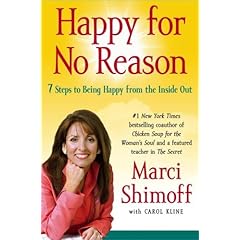
Happy For No Reason explores a part of our psyche. If you take a step back, and think about all the people you interact with, and think about them. Some are eternally happy, and some are grumpy. Studies have shown that most of us reside in the grumpy part of the universe. Just think about all the people you know. How many are happy?
Marci Shimoff explores the many faceted aspects of happiness. Being rich may not buy happiness, buy maybe, happiness can make you rich? As the cartoon on page 32 explains, two guys around the Water Cooler and the caption reads "All I want is a chance to prove money can't make me happy."
Happiness and money are an interesting combination, and a friendship that often fails.
Marci takes a new approach, be happy first, and let the money arrive later.
In Happy For No Reason we get to meet members of what Marci Schimoff refers to as her Happy 100. The book is based on the thoughts and actions of 100 naturally happy people. This eclectic group covers the gamut from rich to poor, and each one has their own unique approach to happiness. This at first makes for a confusing read, there are what seem to be conflicting messages. However if you put it all into the idea-processor (brain), and mull it over for a while, the fog clears. There are some aspects that many of the Happy 100 have in common, and it is only the semantics that change.
Many have faced great adversity in their lives, but adversity is not the key. Adversity is merely the vehicle that created the environment for happiness. The real key is being positive. Having a positive attitude even under the most trying of circumstances is what all of these fine people have in common. Some do it through prayer, being thankful for what they do have, some do it through meditation, some merely revel in the world around them. And the holistic 7-step program at the heart of Happy for No Reason encompasses Happiness Habits for all areas of life: personal power, mind, heart, body, soul, purpose, and relationships.
Happy For No Reason is available from Amazon.
To easily receive updates on future articles, subcribe to Improving Yourself today. Thank you for your time and have a nice day everyone.
Happy for No Reason

Free Ebook | The 7 Habits of Highly Effective People

The Seven Habits of Highly Effective People, first published in 1989, is a self help book written by Stephen R. Covey. It has sold over 15 million copies in 38 languages since first publication, which was marked by the release of a 15th anniversary edition in 2004. The book lists seven principles that, if established as habits, are supposed to help a person achieve true interdependent effectiveness.
habit 1 - be proactive®
This is the ability to control one's environment, rather than have it control you, as is so often the case. Self determination, choice, and the power to decide response to stimulus, conditions and circumstances
habit 2 - begin with the end in mind®
Covey calls this the habit of personal leadership - leading oneself that is, towards what you consider your aims. By developing the habit of concentrating on relevant activities you will build a platform to avoid distractions and become more productive and successful.
habit 3 - put first things first®
Covey calls this the habit of personal management. This is about organising and implementing activities in line with the aims established in habit 2. Covey says that habit 2 is the first, or mental creation; habit 3 is the second, or physical creation.
habit 4 - think win-win®
Covey calls this the habit of interpersonal leadership, necessary because achievements are largely dependent on co-operative efforts with others. He says that win-win is based on the assumption that there is plenty for everyone, and that success follows a co-operative approach more naturally than the confrontation of win-or-lose.
habit 5 - seek first to understand and then to be understood®
One of the great maxims of the modern age. This is Covey's habit of communication, and it's extremely powerful. Covey helps to explain this in his simple analogy 'diagnose before you prescribe'. Simple and effective, and essential for developing and maintaining positive relationships in all aspects of life. (See the associated sections on Empathy, Transactional Analysis, and the Johari Window.)
habit 6 - synergize®
Covey says this is the habit of creative co-operation - the principle that the whole is greater than the sum of its parts, which implicitly lays down the challenge to see the good and potential in the other person's contribution.
habit 7 - sharpen the saw®
This is the habit of self renewal, says Covey, and it necessarily surrounds all the other habits, enabling and encouraging them to happen and grow. Covey interprets the self into four parts: the spiritual, mental, physical and the social/emotional, which all need feeding and developing.
Download free ebook The 7 Habits of Highly Effective People
To easily receive updates on future articles, subcribe to Improving Yourself today. Thank you for your time and have a nice day everyone.